
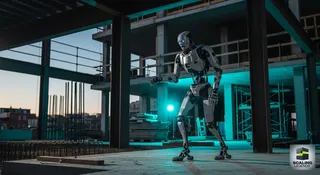
A UK construction firm just handed jobsite inspections to a humanoid robot. Not a quadruped dog. Not a drone. A humanoid. Walking, bending, climbing ladders, capturing LIDAR and visual data. This is not a 2030 story. This is a 2026 story, and the robot is already working.
Interesting Engineering reported on April 23 that this marks the first commercial production deployment of a humanoid robot for construction site inspections. The US construction industry generates $2.1 trillion annually, employs more than 8 million workers, and runs on GC margins averaging 2 to 4 percent. A $1,500-per-week robot doing the work of a $1,800-per-week human safety inspector, available around the clock, is not a curiosity. It is a margin event.
For GCs scaling from $1M to $50M in revenue, this is the moment to build the foundation or get lapped. Smart Business Automator is already tracking nine humanoid construction pilots announced this quarter across the US, UK, and Japan. The window to evaluate intelligently, before competitors do, is measured in months, not years.
Key Takeaways
-
First commercial humanoid deployment confirmed April 2026. A UK construction firm is running a humanoid robot for site inspections in active production, not a lab pilot, capturing 360-degree visual data and LIDAR simultaneously.
-
The ROI math already works. The UK deployment costs approximately $1,500 per week versus $1,800 per week for a human safety inspector, with 24/7 availability baked in. That is a 17 percent cost reduction plus round-the-clock coverage.
-
Humanoid form factor outperforms drones and quadrupeds for structural tasks. Humanoids climb stairs, operate in confined spaces, reach overhead, navigate uneven terrain, and use standard human tools. Drones cannot do any of these.
-
The 12 to 36 month automation horizon is real. Today it is inspection and safety audits. By late 2027, expect basic framing assistance, simple MEP prep work, concrete support tasks, and jobsite logistics.
-
Insurance and regulatory frameworks are forming now. Lloyd’s of London is already writing humanoid liability policies. OSHA autonomous equipment guidance is expected Q3 2026. GCs who wait for full regulatory clarity will be 18 months behind.
-
The Chinese supply chain changes the price floor dramatically. Unitree H1 humanoids are listed at $16,000. When that hardware floods the low-end US market, the barrier to entry for construction robotics drops by a factor of ten.
-
Skilled trades are not being replaced in 2026 or 2027. Every data point confirms humanoids augment supervision and repetitive inspection work first. The threat to skilled labor is a 2029 conversation at the earliest.
The UK Deployment: What the Humanoid Robot Actually Does on a Construction Site in 2026
The UK deployment reported by Interesting Engineering on April 23 is not a demonstration. The robot walks the site autonomously during active construction, captures 360-degree visual data combined with LIDAR point clouds, documents progress against the build plan, and flags safety non-conformances in real time. It climbs ladders. It navigates loose material, uneven substrate, and temporary scaffolding. It enters confined spaces a human safety officer might otherwise skip.
This capability profile matters because it exposes the core limitation of the technologies that preceded it. Drones capture excellent overhead and facade data but cannot enter a confined mechanical room, climb an interior staircase, or open a door. Quadruped robots like early Boston Dynamics Spot deployments handle rough terrain but lack the upper-body range to inspect overhead conditions, reach into ceiling voids, or manipulate basic tools. Humanoids do all of it because the entire built environment was designed around human proportions.
The specific tasks the UK robot handles today map directly to the most expensive line items in construction supervision budgets:
-
Daily progress documentation with photographic and point-cloud capture synced to the BIM model
-
Safety audit walkthroughs flagging PPE non-compliance, unsecured materials, and edge protection gaps
-
As-built verification comparing installed work against design drawings
-
Night patrol and perimeter security, eliminating overnight guard costs on larger sites
-
Confined-space entry inspection for mechanical, electrical, and utility vaults
The data quality from a humanoid is also structurally superior to a human walkthrough. A human inspector produces notes and photos. The robot produces a georeferenced, timestamped, 360-degree point cloud that feeds directly into project management software and can be queried months later during a dispute or claim. For GCs managing construction project management at scale across multiple active sites, that documentation layer alone has defensible insurance and legal value that far exceeds the weekly cost.
The average construction site loses 2.3 hours per day to rework caused by poor progress documentation. On a $5M project, that is $180,000 in rework exposure. A robot that documents every day, every floor, every trade creates the paper trail that prevents those disputes from becoming claims.
The Competitive Field: Boston Dynamics, Figure 02, and the Robots Headed to Your Jobsite
Seven platforms are now competing for the construction robotics market. Understanding the competitive landscape is essential for any GC evaluating pilot programs, because the hardware you lock into today becomes a software and integration decision that compounds over five years.
Boston Dynamics Atlas is the most capable platform in terms of dynamic movement but remains the most expensive and least commercially available for mid-market contractors. Atlas is currently targeting automotive and heavy industrial deployments. The construction window for Atlas is more likely 2027 to 2028 for GCs outside the top 50 by revenue.
Figure 02 signed a manufacturing partnership with BMW and is building toward commercial availability in late 2026. Figure’s software stack is notable because it is built on top of large-scale visual imitation learning, meaning the robot learns new tasks faster than systems requiring manual programming. For construction, that means a faster path from inspection to light assembly tasks.
Agility Robotics Digit is the most mature US platform for logistics and indoor navigation. Amazon is already deploying Digit in warehouses. The step from warehouse logistics to construction site logistics is smaller than it appears, and Agility has a clear 2026 to 2027 construction roadmap.
Unitree H1 at $16,000 is the price disruptor. Chinese manufacturing economics have produced a capable bipedal robot at roughly one-tenth the price of US and European competitors. Tariff debates and national security reviews are incoming, but $16K hardware changes what a small GC can afford to pilot. The CONEXPO 2026 floor made clear that the hardware price war is already underway.
Other platforms in the competitive field include UBTech Walker X, Apptronik Apollo (which counts NASA among its development partners), and Sanctuary AI, which is focused on general-purpose manipulation tasks that apply directly to assembly work. The competitive picture is not one winner. It is a fragmented market with different cost structures, capability profiles, and deployment timelines. GCs should evaluate based on the specific tasks they want to automate first, not on brand recognition.
Contractor Profit Margins 2026: The ROI Math Behind Humanoid Robots and Construction Cash Flow Management
The business case for humanoid robots in construction is not theoretical. The numbers from the UK deployment are already public, and they close at current hardware and labor costs.
A human safety inspector in the UK costs approximately £1,400 per week all-in, translating to roughly $1,800 at current exchange rates. The humanoid deployment runs approximately $1,500 per week. That is a 17 percent direct cost reduction on the inspection line item before accounting for availability. A human inspector works one shift, five days a week. The robot works 24 hours a day, seven days a week, for the same weekly cost.
Run the math on a typical 18-month commercial project:
-
Human safety inspector cost over 78 weeks: $140,400
-
Humanoid robot cost over 78 weeks: $117,000
-
Direct savings: $23,400
-
Additional value from 24/7 availability: night security, after-hours documentation, weekend progress capture
-
Documentation dispute prevention value: estimated $15,000 to $60,000 depending on project complexity
The total ROI case for a single 18-month project is $38,000 to $83,000 before factoring in insurance adjustments or reduced OSHA citation exposure.
For GCs already working on construction cash flow management at the $5M to $20M revenue tier, the humanoid robot shifts a fixed labor cost into a variable technology cost that scales down between projects. You do not pay the robot during the gap between contracts. That cash flow flexibility has real value on a 2 to 4 percent margin business where float is everything.
The insurance angle compounds the ROI further. Sites with documented autonomous inspection data are reporting preliminary premium discussions with carriers that include 5 to 12 percent reductions on general liability lines. Lloyd’s is actively building that actuarial model. GCs who deploy humanoid inspection now accumulate the data history that makes those discounts concrete in 2027 and 2028.
The Task Automation Horizon: What Construction Project Management Software Cannot Replace in 12 to 36 Months
The clearest mistake GCs make when evaluating robotics is conflating what robots can do in a lab with what they will do commercially at scale and at what timeline. The task horizon breaks into three distinct windows.
Production-ready today (2026): The UK deployment confirms six task categories are commercially viable right now. Inspection and documentation, safety audit walkthroughs, confined-space entry, night patrol and site security, as-built verification, and real-time progress reporting against BIM models. These are the tasks where the robot’s data quality exceeds human output and the cost math already closes.
12 to 24 months (2027 to mid-2028): Basic framing assistance on repetitive residential and light commercial projects, simple MEP rough-in support (material staging, conduit carrying, fixture positioning), prep work for painting and finishing trades, and basic concrete form support. These tasks require more dexterous manipulation than current platforms deliver reliably, but the learning curve on Figure 02 and Agility Digit suggests commercial viability within 18 months.
24 to 36 months (2028 to 2029): More complex assembly work on standardized components, jobsite logistics and material movement across large sites, painting prep and surface preparation, and integration with autonomous material delivery systems. This window also includes the beginning of multi-robot coordination on larger projects.
What does not get automated in this window: Custom fabrication, complex problem-solving on non-standard conditions, client communication, trade coordination requiring judgment calls, and any task requiring regulatory licensing. Electricians, plumbers, and ironworkers are not threatened by humanoid robots in the 36-month window. The construction workflow automation conversation for skilled trades remains a 2030-plus story.
The Smart Business Automator robotics tracker currently counts nine humanoid construction pilots announced in the US, UK, and Japan this quarter alone. The projection for US market penetration is 5 to 10 percent of GCs with annual revenue above $50M running active pilots by Q4 2027. For mid-market contractors in the $5M to $50M tier, the window to learn at low cost before the technology matures into a competitive differentiator is the next 12 months.
Insurance, OSHA, and Privacy Law: The Regulatory Reality for Construction Business Growth 2026
The regulatory picture is incomplete but moving faster than most GCs expect. Three frameworks are forming simultaneously, and each one creates both risk and opportunity depending on how early a contractor engages.
Insurance: Lloyd’s of London syndicates are actively writing humanoid robot liability policies for commercial construction deployments. The product is not yet standardized, which means early adopters have leverage to negotiate coverage terms before actuarial tables harden. Key questions in current policy negotiations include incident liability during autonomous navigation, data breach liability for camera systems capturing worker biometrics, and equipment damage during site operations. GCs who pilot in 2026 accumulate the safety record that drives favorable premium adjustments by 2028.
OSHA: The agency’s autonomous equipment guidance is expected in Q3 2026. Based on prior OSHA rulemaking patterns, expect framework guidance rather than prescriptive standards, with a 12 to 18 month comment period before any enforcement teeth. The practical implication is that 2026 deployments operate in a guidance gap, which means internal safety protocols, worker training documentation, and incident reporting procedures need to be built by the GC rather than mandated. That is a burden, but it is also an opportunity to build the operational playbook that competitors will copy later.
Privacy law: This is the most immediate compliance risk and the most underestimated. California’s BIPA equivalent and Illinois Biometric Information Privacy Act both require written worker notice before capturing biometric data, which includes facial geometry captured by robot cameras. Retention policies, deletion schedules, and worker consent documentation are required. A violation in Illinois currently carries $1,000 per negligent violation and $5,000 per intentional violation, with class action exposure. Any humanoid deployment on a union job or a multi-employer site in California or Illinois needs legal review before the robot walks through the gate.
For GCs focused on scaling construction business operations while managing regulatory complexity, the robotics compliance stack is best built now, while enforcement is light, rather than retrofitted after an incident or citation.
The Chinese Supply Chain and the $16,000 Humanoid: What US Contractors Need to Know
Unitree Robotics H1 is listed at $16,000. For context, Boston Dynamics Spot quadruped starts at $75,000 and does not walk on two legs. The price differential is not a quality story, at least not entirely. It is a manufacturing economics story, and it reshapes the accessibility of construction robotics for every GC below the $50M revenue tier.
The H1 has already been deployed in research environments at major US universities and is showing up in construction technology pilot announcements in Europe and Southeast Asia. It handles bipedal locomotion, basic manipulation, and remote teleoperation. The software ecosystem is less mature than Figure or Agility, and the safety certification path for US commercial construction is unclear. But at $16,000, the barrier to run a 90-day internal pilot on a single large project drops to a rounding error in most GC operating budgets.
The national security and tariff debate is coming. The same political dynamics that produced Section 232 steel tariffs and the Huawei equipment ban are already surfacing in congressional discussions about Chinese robotics. The specific risk for GCs considering Unitree hardware is that a tariff action or export restriction in 2027 could strand a technology investment and complicate parts supply and software update access. That is a real but manageable risk for a pilot program. It is a larger risk for a full fleet commitment.
The practical guidance is straightforward: use Chinese hardware to learn and evaluate at low cost, but do not build long-term operational dependencies on it until the trade and regulatory picture clarifies. The learning from a $16,000 Unitree pilot is directly transferable to a Figure 02 or Agility Digit deployment. The robotics skill set your team builds is platform-agnostic.
Smart Business Automator’s construction market intelligence tracking shows that the tariff risk on Chinese robotics hardware is being actively discussed in Washington, with draft language expected to surface in the next defense authorization cycle. GCs who are evaluating Chinese platforms should factor an 18 to 36 month hardware availability window, not a permanent low-cost supply chain.
Frequently Asked Questions
What does a humanoid construction robot actually do on a jobsite today?
In the current commercial deployment in the UK, the humanoid robot walks the site autonomously, captures 360-degree visual data combined with LIDAR point clouds, documents daily progress against the BIM model, flags safety non-conformances in real time, conducts night patrols, and enters confined spaces. It operates 24 hours a day, seven days a week, and produces georeferenced, timestamped documentation that feeds directly into project management software. Six production task categories are commercially viable as of April 2026.
How much does a humanoid construction robot cost compared to a human safety inspector?
The UK deployment runs approximately $1,500 per week versus $1,800 per week for a human safety inspector at equivalent market rates. Over an 18-month project, that translates to $23,400 in direct labor savings. Add 24/7 availability value, documentation quality benefits, and preliminary insurance premium reductions of 5 to 12 percent on general liability, and the total ROI case for a single project reaches $38,000 to $83,000 depending on project complexity.
Will humanoid robots replace construction workers or skilled trades in 2026 or 2027?
No. Every current data point confirms humanoids augment supervision and repetitive inspection work, not skilled trade execution. Electricians, plumbers, ironworkers, and carpenters are not threatened in the 12 to 36 month window. The 2026 to 2028 deployment window targets inspection, documentation, safety auditing, night patrol, and confined-space entry. More complex assembly work is a 2028 to 2029 story at the earliest for commercial deployments. The labor disruption conversation for skilled trades starts around 2029 to 2030.
What regulations apply to humanoid robots on US construction sites in 2026?
OSHA autonomous equipment guidance is expected Q3 2026 but will be framework-level, not prescriptive enforcement. The most immediate compliance risk is state biometric privacy law. Illinois BIPA and California equivalents require written worker notice before capturing biometric data, with per-violation penalties reaching $5,000 and class action exposure. Any humanoid deployment on union jobs or multi-employer sites in those states needs legal review before rollout. Lloyd’s of London is actively writing liability policies, but coverage terms are not yet standardized.
How do I start evaluating a humanoid robot pilot for my construction company?
Start with a single project inspection use case on a project over $3M in contract value. The ROI math closes reliably at that project size. Evaluate platforms based on the specific tasks you want to automate first, not brand recognition. Consider a Unitree H1 at $16,000 to build internal competency before committing to a higher-cost US platform. Engage legal counsel on biometric data compliance before the robot walks on site. Build your internal safety protocol documentation now, before OSHA formalizes requirements. The 90-day pilot window is enough to generate meaningful data on cost, quality, and operational friction.
How to Evaluate a Humanoid Robot Pilot for Your Construction Business in 2026
-
Select one project above $3M contract value as your pilot site. The ROI math requires enough inspection volume to generate meaningful data. A single-family residential project does not produce enough daily inspection touchpoints to validate the cost model. A $5M to $15M commercial or multi-family project hits the right scale for a 90-day evaluation.
-
Identify your three highest-cost inspection and documentation tasks on that project. Safety audits, progress documentation disputes, and confined-space entry are the categories where humanoid robots consistently outperform human labor on quality and cost. Map your current weekly labor cost for those three tasks as your baseline.
-
Get a legal review on biometric privacy compliance before any hardware arrives on site. If the project is in California or Illinois, your attorney needs to draft worker notice documentation and a data retention policy before the robot captures a single frame. This is a 2 to 4 week process. Start it during hardware evaluation, not after signing a contract.
-
Evaluate two hardware platforms in parallel, not sequentially. Request demonstration data from at least one US platform (Figure, Agility, or Apptronik) and price the Unitree H1 for comparison. The capability gap at the inspection task level is smaller than the price gap suggests. Your evaluation criteria should weight software integration with your existing project management platform equally with hardware capability.
-
Build internal documentation protocols for the pilot from day one. Every safety flag the robot raises, every progress documentation capture, every incident, and every operational friction point needs to be logged. This data becomes your insurance negotiation asset in year two and your competitive advantage in bidding conversations where owners ask about technology capability.
-
Set a 90-day decision gate with three specific metrics. Define in advance the documentation quality score, cost per inspection hour, and safety audit coverage rate you need to see to justify a full project deployment or a fleet expansion. Pilots without pre-defined metrics drift. Pilots with clear gates produce actionable decisions.
-
Assign one team member as your robotics operations lead for the pilot duration. This person manages hardware, coordinates with workers on site, fields the biometric compliance questions, and owns the evaluation metrics. A diffuse responsibility model produces inconclusive pilots. One owner produces a decision.
The Bottom Line: One Action to Take This Week on Construction Business Growth 2026
The UK deployment is not an anomaly. It is the leading edge of a technology curve that will reach the US mid-market within 12 to 18 months. The family construction business growth playbook for 2026 includes technology literacy on robotics, not just software adoption. GCs who understand the task horizon, the regulatory landscape, and the ROI math before their competitors do will win the early pilot opportunities from owners who are already asking about autonomous site monitoring in their RFP language.
This week: pull your last three months of safety inspector invoices and calculate your current weekly cost for inspection and documentation labor on your largest active project. That number is your baseline. Compare it to $1,500 per week with 24/7 availability. If the gap is meaningful and the project is at the right scale, the next step is a hardware demo, not a committee meeting. The robot is already working on a jobsite in the UK. The question is whether it is working on yours before it is working on your competitor’s.